
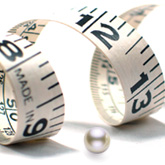
Three things determine the size of a cultured pearl: the size of the mother-of-pearl nucleus, the size of the oyster, and the thickness of the nacre. Size is an important value factor. Certain sizes that are in fashion demand, may command premium prices. Supply and demand are the over-riding factors. Round pearls are measured according to their diameter, while baroque pearls are measured by their length and width. Size is determined by diameter and expressed in millimeters, since pearls are sold by the millimeter.
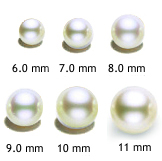
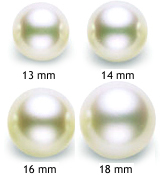
Cultured pearls are sold by millimeter size (one millimeter approx equals 1/25 inch): their measurements indicates the diameter of round pearls, and the length and width if not round. The larger the pearl, the greater the cost. A 2 millimeter cultured pearl is considered very small, whereas Akoya cultured pearls over 8 millimeters are considered very large; in South Sea pearls, an 8 mm pearl is small, 13-15 millimeters is average, and over 16 millimeters is very large. Large cultured pearls are rarer and more expensive.
In Akoya cultured pearls there is a dramatic jump in the cost after 7 1/2 millimeters. Pearl strands are sorted by size, with a specific millimeter range: Petite: 6 millimeters and below; Classic: 6 to 7.5 millimeters; Most Popular: 7 to 7.5 millimeters; Outstanding: 8 millimeters. A pearl's size doesn't necessarily indicate its quality, but it most certainly does affect its price. All things considered, the larger the pearl, the higher its value.
 Which Size
is Right?
Which Size
is Right?

Pearl strands are sorted by size, with a specific millimeter range: Petite: 6 millimeters and below; Classic: 6 to 6.5 millimeters; Most Popular: 7 to 7.5 millimeters; Outstanding: 8 to 8.5 millimeters. A pearl's size doesn't necessarily indicate its quality, but it most certainly does affect its price. All things considered, the larger the pearl, the higher its value.
 Shop Pearl Jewelry


Why
Buy From Us | References
| Site Security
| Guarantee | Return
Policy | Buyer's
Tips | FAQ | Site
Map
Product
Education | Live
Online Help | Search
Our Website | Customer
Service | Contact
Us | Payment Options
| Sales Tax
Shipping
Charges | Service
Center | Order
Tracking | Platinum
Facts | Ring Sizing
| Engraving Options
| Polishing
How
To Order | After
Sales Service | Legal
| Terms & Conditions
| Disclaimer | Product
Policies | Security
info@sndgems.com | © 2000 Sndgems Inc. | 1-800-871-1066 / 1-614-921-9024